Flash USDT Explained New Creation Method
· based on the channel Rca FastPrint
Flash USDT is a novel approach to creating and interacting with USDT tokens on the Ethereum blockchain using a developer-friendly environment called ChainIDE. This method leverages smart contract development and wallet integration to simulate or test Flash USDT tokens safely without risking real funds. The process involves deploying ERC20-compatible contracts and connecting to MetaMask for transaction signing and interaction.
Understanding Flash USDT and Its Purpose
Flash USDT refers to a token creation technique that mimics USDT behavior on the Ethereum network, often used for testing, development, or educational purposes. Unlike real USDT tokens issued by Tether, Flash USDT tokens are generated through custom smart contracts deployed in ChainIDE, providing users with a sandbox environment. This method enables developers and testers to experiment with token mechanics, transfers, and contract interactions without involving real cryptocurrency.
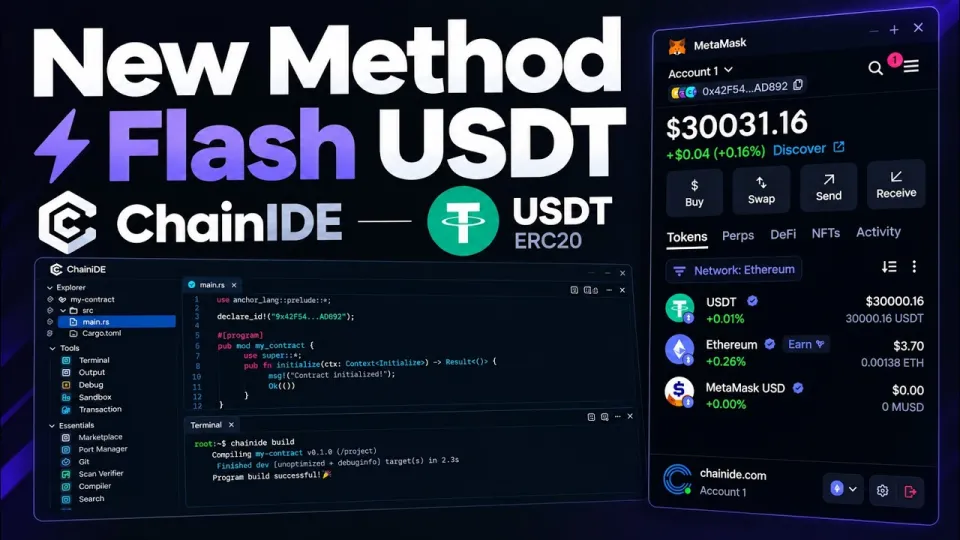
Video: Flash USDT | Found a NEW Method on ChainIDE
Setting Up ChainIDE for Flash USDT Creation
ChainIDE is an online integrated development environment tailored for blockchain development, including Ethereum smart contracts. To create Flash USDT tokens:
- Register or access ChainIDE at https://chainide.com/ to use its Ethereum development tools.
- Load or write the ERC20 token smart contract source code designed for Flash USDT creation.
- Compile and deploy the contract on a testnet or a local development Ethereum network supported by ChainIDE.
- Use ChainIDE’s interface to monitor contract deployment status and retrieve the contract address.
ERC20 Token Structure in Flash USDT
The Flash USDT tokens adhere to the ERC20 token standard, which defines a common set of functions and events for fungible tokens on Ethereum. Key elements include:
- Total Supply: The maximum number of tokens minted at deployment.
- Balance Tracking: Mapping of user addresses to token balances.
- Transfer Functions: Methods to send tokens between addresses.
- Allowance and Approval: Mechanisms allowing third parties to spend tokens on behalf of owners.
Understanding these components is crucial for creating functional Flash USDT tokens that behave like genuine ERC20 tokens.
Integrating MetaMask for Wallet Interaction
MetaMask serves as the bridge between users and the Ethereum blockchain, allowing wallet management and transaction signing:
- Install MetaMask and configure it to connect to the Ethereum test network used by ChainIDE.
- Import or create a wallet within MetaMask.
- Connect MetaMask to ChainIDE’s deployed Flash USDT contract by adding the contract address.
- Interact with the contract’s functions (e.g., transfer, approve) directly through MetaMask’s interface or ChainIDE’s UI.
This integration enables users to simulate token transactions and contract calls securely.
Smart Contract Development Workflow
Developing Flash USDT tokens involves several steps:
- Writing the Contract: Use Solidity to code the ERC20 token contract, ensuring it includes Flash USDT specific parameters.
- Compiling: Translate Solidity code into EVM bytecode within ChainIDE.
- Deploying: Send the compiled contract to an Ethereum testnet through ChainIDE, paying gas fees with test ETH.
- Testing: Execute contract functions to verify behavior, such as minting and transferring tokens.
- Verification: Confirm contract code and deployment address to ensure legitimacy.
This workflow promotes thorough testing and understanding before any real asset interaction.
Common Mistakes and Safety Checks
Before interacting with Flash USDT contracts, consider these precautions:
- Always verify the contract address and source code independently.
- Confirm you are connected to the correct Ethereum network to avoid loss of funds.
- Never send real funds to unknown or unverified contracts.
- Test transactions with small amounts or on testnets before any mainnet deployment.
These steps protect users from scams and unintended losses.
Useful Links
- ChainIDE official site and development platform: https://chainide.com/
- ChainIDE Script for Flash USDT creation tutorial: https://sites.google.com/view/defiflashusdt
Итог
Flash USDT is an innovative method to create and test USDT-like tokens using the ChainIDE environment and MetaMask wallet integration. This approach provides a safe space for developers and enthusiasts to understand ERC20 token mechanics and smart contract workflows without risking real assets. The detailed process from contract coding to testing emphasizes security and education. For further insights and step-by-step guidance, refer to the original tutorial by the Rca FastPrint channel. To start creating your own Flash USDT tokens, visit ChainIDE at https://chainide.com/ and explore their powerful tools.
Key takeaways
- Flash USDT creation uses ChainIDE and MetaMask integration
- Method involves ERC20 token structure on the Ethereum network
- Development workflow includes smart contract coding and testing
- Important to verify contract and network before transactions
- Tutorial aims at educational and testing purposes only
Source: Flash USDT | Found a NEW Method on ChainIDE · Markdown version
Questions & answers
What is Flash USDT and how does it differ from real USDT?
Flash USDT is a developer-created token that mimics USDT functionality on the Ethereum network for testing and educational purposes. Unlike real USDT issued by Tether, Flash USDT tokens are custom smart contracts deployed in a controlled environment and do not hold real monetary value.
How does ChainIDE facilitate the creation of Flash USDT tokens?
ChainIDE is an online blockchain development platform that provides tools to write, compile, deploy, and test smart contracts. It allows users to create Flash USDT tokens by deploying ERC20 contracts on testnets, enabling safe experimentation without financial risk.
Why is MetaMask integration important in the Flash USDT method?
MetaMask acts as a wallet interface that connects users to the Ethereum blockchain, allowing them to manage token balances, sign transactions, and interact securely with deployed smart contracts like Flash USDT tokens.
What precautions should be taken before interacting with Flash USDT contracts?
Users should verify contract addresses and source code, ensure they are on the correct Ethereum network, avoid sending real funds to unverified contracts, and perform thorough testing on testnets to prevent scams and loss of assets.